Key Takeaways
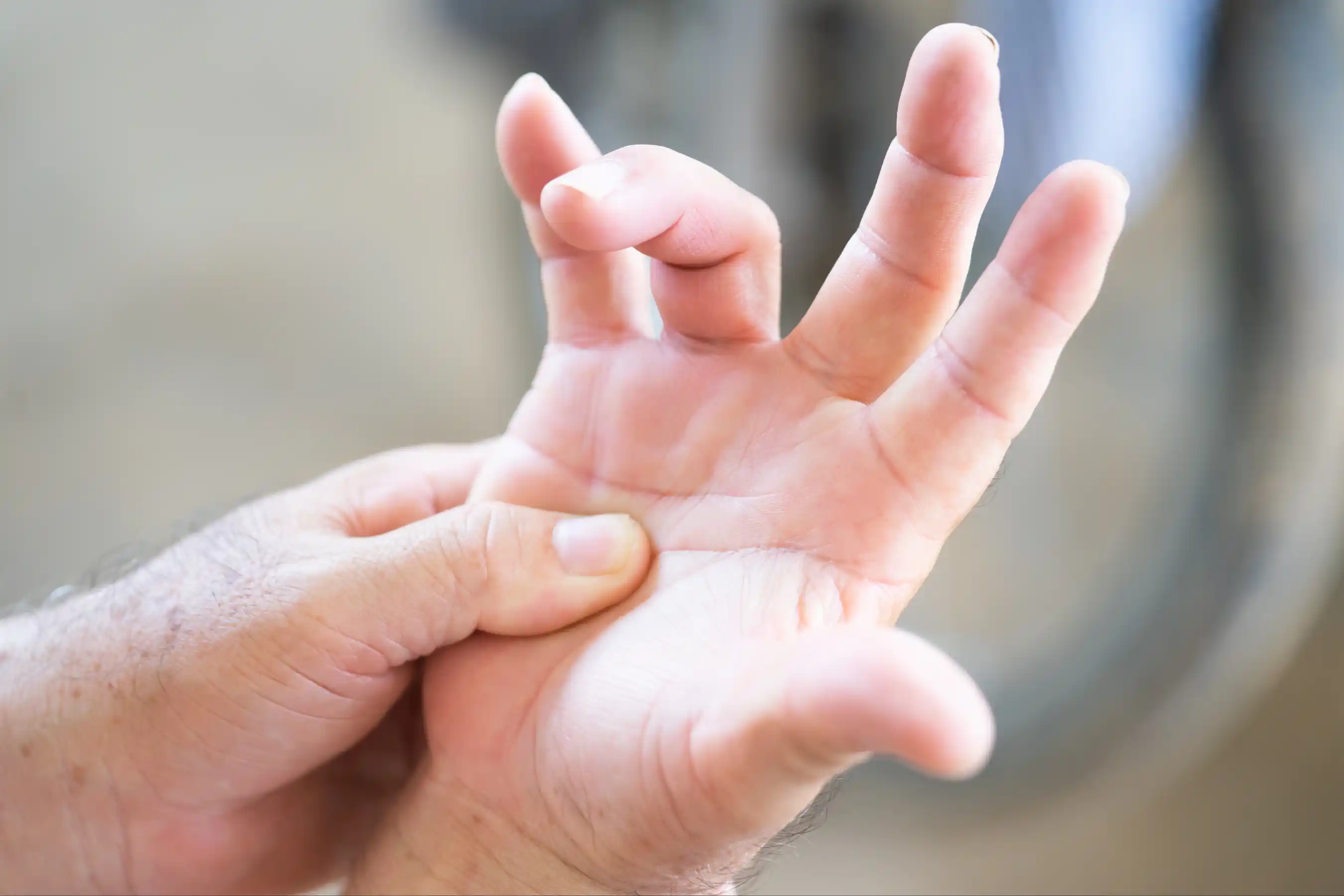
- A finger that catches, clicks, or locks usually points to trigger finger, while a finger that slowly curls toward the palm and won't straighten often points to Dupuytren's contracture.
- Trigger finger is a tendon problem at the base of a finger or thumb that can make the digit hard to both bend and straighten.
- Dupuytren's contracture is a thickening of the tissue under the skin of the palm that pulls fingers down, but it does not stop you from making a fist.
- Most trigger fingers improve with rest, splinting, hand therapy, or an injection, and a quick release procedure is an option when they don't.
- Dupuytren's contracture has no cure, but treatment can straighten a finger once it starts getting in the way of daily tasks.
- Dr. Mark A. Yaffe is a double board-certified hand surgeon serving Schaumburg, Buffalo Grove, Elk Grove Village, and Bartlett, IL. Request an appointment online or call (847) 285-4200 to have your finger checked.
Why Fingers Lock, Catch, or Curl
Your fingers rely on tendons, pulleys, and thin layers of tissue that all have to glide smoothly so you can grip a steering wheel, type, or button a shirt. When one of those parts thickens or swells, a finger can start to catch, lock, or slowly pull toward your palm.
Two conditions cause most of these problems: trigger finger and Dupuytren's contracture. Both can make a finger hard to straighten, so people often mix them up. However, they start in different tissues, feel different, and are treated differently.
Dr. Mark A. Yaffe holds two board certifications from the American Board of Orthopaedic Surgery: one in orthopaedic surgery and a subspecialty certification in hand surgery. He completed fellowship training in hand and upper extremity (arm) surgery at The Indiana Hand to Shoulder Center and was named a Castle Connolly Top Doctor in 2026. He performs almost 90% of his surgeries at Schaumburg Surgery Center, located inside the main office of Barrington Orthopedic Specialists. Patients across the northwest suburbs see him for trigger finger treatment and other hand conditions at his offices in Schaumburg, Buffalo Grove, Elk Grove Village, and Bartlett.
What Is Trigger Finger?
Trigger finger is the common name for stenosing tenosynovitis, which means the protective tunnel around a finger tendon has narrowed and swollen. Tendons are cords that connect your forearm muscles to your finger bones. They slide through a series of tissue bands, called pulleys, that hold them close to the bone.
In trigger finger, the first pulley at the base of the finger, called the A1 pulley, thickens. The tendon may also develop a small bump called a nodule. Instead of gliding through the pulley, the tendon catches and then snaps free. That snap is the 'trigger' that gives the condition its name.
Trigger finger is common. According to Hospital for Special Surgery, it affects between 1% and 2% of the population and as many as 20% of people with high risk factors.
What Trigger Finger Feels Like
Symptoms often start mild and get worse over time. Common signs include:
- A snapping, popping, or clicking feeling when you bend or straighten the finger
- Soreness in the palm at the base of the finger, especially when you grip something
- A tender lump at the base of the finger
- Stiffness that is worst when you wake up and eases as you use your hand
- A finger that locks in a bent position and needs your other hand to straighten it
Cleveland Clinic notes that 1 in 3 people with trigger finger have it in more than one finger at a time. It can also show up in both hands.
Trigger Thumb
Trigger thumb is the same tendon problem in the thumb. You may feel catching or soreness at the base of the thumb when you pinch or grip, and the thumb may get stuck in a bent position. Trigger thumb is evaluated and treated the same way as trigger finger.
What Is Dupuytren's Contracture?
Dupuytren's contracture is a condition that makes one or more fingers bend toward the palm. It starts in the palmar fascia, a layer of tough tissue just under the skin of the palm. Over time, this tissue thickens and shortens into cords that pull the fingers down.
According to Mayo Clinic, the condition often gets worse slowly, over years. It most often affects the ring finger and little finger, and it typically affects both hands. As the fingers bend, everyday tasks like putting on gloves, shaking hands, and reaching into pockets get harder.
Early Signs of Dupuytren's Contracture
- A firm lump or thickened skin in the palm, which is usually painless
- Puckering or dimpling of the skin of the palm
- A cord under the skin that runs from the palm into a finger
- A finger that slowly curls toward the palm
- Trouble laying your hand flat on a table
That last sign is the basis of a simple self-check called the tabletop test. If you can't place your palm and fingers flat on a table, it's a good time to have your hand evaluated.
There is no cure for Dupuytren's contracture. However, treatment can relieve symptoms and slow how quickly the condition gets worse.
Trigger Finger vs. Dupuytren's Contracture: Key Differences
Because both conditions can leave a finger bent, the details matter. Hospital for Special Surgery explains that Dupuytren's contracture makes it hard to fully straighten a finger but never causes a problem making a fist, while trigger finger can make it hard to both bend and straighten.
| Feature | Trigger Finger | Dupuytren's Contracture |
|---|---|---|
| Tissue involved | The tendon and its pulley at the base of the finger | The fascia, a tissue layer just under the skin of the palm |
| How it feels | Catching, clicking, popping, or locking, often painful | Slow, gradual curling, usually painless |
| Making a fist | May be hard to bend and to straighten | Making a fist is not a problem, but straightening is |
| What you may feel | A tender lump at the base of the finger | Firm lumps or cords in the palm |
| Fingers involved | Any finger or the thumb | Most often the ring and little fingers |
| Pattern | Often worst in the morning | Progresses slowly over months to years |
| First steps in care | Rest, splinting, hand therapy, injections | Monitoring until the finger limits daily tasks |
It is also possible to have both. The two conditions sometimes show up in the same hand, which is one reason a hands-on exam by a hand surgeon is so useful.
Risk Factors for Trigger Finger and Dupuytren's Contracture
Trigger Finger Risk Factors
- Being between the ages of 40 and 60
- Being a woman
- Frequent or forceful gripping, such as gardening, working with tools, playing an instrument, or playing racket sports like tennis and pickleball
- Health conditions such as diabetes, rheumatoid arthritis, gout, or an underactive thyroid
Diabetes stands out. Hospital for Special Surgery reports that between 5% and 20% of people with diabetes will develop trigger finger.
Dupuytren's Contracture Risk Factors
- Being over age 50
- Being a man, since symptoms may be worse and progress faster in men
- Having a family history of the condition
- Having diabetes
- Smoking and drinking alcohol, which some studies have linked to higher risk
- Using vibrating tools, which some studies have linked to the condition
How Dr. Yaffe Diagnoses a Locking or Curling Finger
Both conditions are usually diagnosed with a conversation and a hands-on exam. Imaging is generally not needed unless another problem is suspected.
During your visit, Dr. Yaffe will:
- Ask when the problem started, which fingers are involved, and when symptoms are worst
- Press along the palm to check for tenderness, nodules, or cords
- Watch as you bend and straighten the finger to feel for catching or locking
- Measure how far any curled finger joints are bent
- Order an ultrasound or X-rays if he needs a closer look at the tendon, tissue, or bones
Before your appointment, it helps to note which finger is affected, when it locks most, and whether you can lay your hand flat.
Splinting and Injections: First-Line Trigger Finger Treatment
Most trigger fingers can be managed without surgery, especially when they are caught early. Dr. Yaffe starts with the least invasive approach that will work for you.
| Treatment | How It Helps | Good to Know |
|---|---|---|
| Rest and activity changes | Gives the irritated tendon time to calm down | Cutting back on gripping for 1 to 2 weeks is a common first step |
| Night splint | Keeps the finger straight while you sleep | Especially helpful when symptoms are worst in the morning |
| Hand therapy | Stretches, gentle exercises, and tips to protect the tendon | Led by a certified hand therapist |
| Anti-inflammatory medication | Eases pain and swelling | Includes over-the-counter options like ibuprofen or naproxen |
| Steroid injection | Reduces swelling around the tendon | May take a few weeks to work |
| Trigger finger release | Opens the tight pulley so the tendon can glide | Used when symptoms persist or the finger stays locked |
Splinting and Activity Changes
Cutting back on gripping and squeezing gives the tendon a chance to settle. A splint worn at night holds the finger straight so it doesn't curl into a fist while you sleep, which can ease morning stiffness and locking.
Steroid Injections
A corticosteroid injection is a shot of anti-inflammatory medicine placed near the tendon. Hospital for Special Surgery describes these injections as very safe and effective at curing trigger finger in many patients. It also advises avoiding more than two or three injections in the same finger to prevent complications. Cleveland Clinic notes that injections usually take a few weeks to relieve symptoms.
Orthobiologic Options
Dr. Yaffe also offers biologic injection therapy, sometimes called orthobiologics, for certain tendon and joint problems. One example is platelet-rich plasma (PRP), which uses a concentrated sample of your own blood to support healing. Ask Dr. Yaffe whether a biologic option makes sense for your finger.
When Trigger Finger Release Surgery Is Considered
Surgery is usually discussed when:
- Symptoms keep coming back despite splinting, therapy, or injections
- The finger locks often or gets stuck in a bent position
- Pain or stiffness interferes with work, hobbies, or sleep
Timing matters. Hospital for Special Surgery advises that when non-surgical care fails, surgery should be done promptly to keep the finger from becoming permanently bent.
Minimally Invasive Trigger Finger Release With Local Anesthesia
Through a small incision at the base of the finger, Dr. Yaffe opens the tight portion of the pulley that is catching the tendon. This allows the tendon to glide freely again.
Dr. Yaffe prefers local anesthesia, or numbing medicine, for most finger and hand procedures, including trigger finger release. This avoids sedation by an anesthesiologist and is less invasive and less expensive than general anesthesia. For a closer look at the procedure and healing, read Dr. Yaffe's guide to trigger finger and trigger thumb surgery.
Minimally Invasive and Surgical Options for Dupuytren's Contracture
Mild Dupuytren's contracture, where the fingers still straighten fully, is often just monitored. Treatment is usually considered once a finger can't straighten enough to lay the hand flat or the curl is clearly getting worse. Hand surgeons use several approaches:
| Option | How It Works | Recovery | Chance of Returning |
|---|---|---|---|
| Needle aponeurotomy | A needle is passed through the skin under local anesthesia to weaken and break the cord | Quick | Higher than after surgery |
| Collagenase injection | An enzyme, a protein that breaks down tissue, is injected into the cord to weaken it, and the finger is straightened a day or so later | Quick | Higher than after surgery |
| Fasciectomy | The surgeon opens the palm and finger and removes the thickened tissue | Several weeks to a few months | Lowest, with the longest-lasting correction |
Dr. Yaffe will measure how far each finger is bent and walk you through which option fits your hand and your goals. For a closer look at each approach, read his guide to Dupuytren's contracture treatment options.
Recovery and Hand Therapy
After Trigger Finger Release
Dr. Yaffe will give you specific instructions for caring for the incision, when to start moving the finger, and when to return to your usual activities. Because the procedure is minimally invasive and done with local anesthesia, many patients return to light daily activities quickly and need little formal therapy afterward. Recovery varies from person to person and with the number of fingers treated.
After Dupuytren's Contracture Surgery
After a fasciectomy, the hand is usually placed in a bulky dressing and often a splint. Stitches are typically removed within 10 to 14 days. Hand therapy helps restore motion and keep the finger straight, and a night splint may be used for a while. Light daily use often returns within a couple of weeks, while heavier use and full motion can take several weeks to a few months.
Can These Conditions Come Back?
Dupuytren's contracture is a long-term condition, so cords can return months or years after any treatment. They tend to come back sooner after needle or injection treatment than after surgery. A recurrence can often be treated again.
When to See a Hand Surgeon Near You
Make an appointment if:
- Your finger locks and you need your other hand to straighten it
- Catching or pain hasn't improved after a week or two of rest
- Pain or stiffness gets in the way of work, hobbies, or sleep
- You can't lay your hand flat on a table
- A finger is curling more than it used to
If you suddenly can't move or use a finger or thumb at all, go to the emergency room.
Visit Dr. Yaffe in Schaumburg, Buffalo Grove, Elk Grove Village, or Bartlett
You can schedule with Dr. Yaffe at any of the Barrington Orthopedic Specialists offices below by calling (847) 285-4200.
| Office | Address |
|---|---|
| Schaumburg | 929 West Higgins Road, Schaumburg, IL 60195 |
| Buffalo Grove | 404 North McHenry Road, Buffalo Grove, IL 60089 |
| Elk Grove Village | 120 East Higgins Road, Elk Grove Village, IL 60007 |
| Bartlett | 864 West Stearns Road, Bartlett, IL 60103 |
Get Your Finger Moving Freely Again With Dr. Mark A. Yaffe
Trigger finger and Dupuytren's contracture can both leave a finger bent, but they need different care, and both are easier to treat when they are caught early. Dr. Yaffe starts with the least invasive option that will work and offers minimally invasive release with local anesthesia when it's time for the next step.
Request an appointment online with Dr. Mark A. Yaffe for trigger finger treatment or a Dupuytren's contracture evaluation, or call (847) 285-4200 to schedule a visit at his Schaumburg, Buffalo Grove, Elk Grove Village, or Bartlett office.
Frequently Asked Questions
How can I tell if I have trigger finger or Dupuytren's contracture?
Trigger finger usually causes catching, clicking, or locking, and it can hurt at the base of the finger. Dupuytren's contracture usually causes a slow, painless curl with firm cords in the palm, and it doesn't stop you from making a fist. A hand surgeon can tell the difference with a quick exam.
Can trigger finger go away on its own?
According to Hospital for Special Surgery, mild cases can resolve on their own. Resting the hand and cutting back on gripping can help. A finger that keeps catching, hurts often, or stays bent usually needs treatment, such as a splint, an injection, or a release procedure.
Will I be put to sleep for trigger finger surgery?
Probably not. Dr. Yaffe prefers local anesthesia for most finger and hand procedures, including trigger finger release. This avoids sedation by an anesthesiologist and is less invasive and less expensive than general anesthesia. He will confirm the plan with you before your procedure.
Does Dupuytren's contracture come back after treatment?
It can. Treatment straightens the finger but doesn't cure the condition, so cords may return months or years later. They tend to come back sooner after needle or injection treatment than after surgery, and a recurrence can often be treated again.
Does diabetes raise the risk of trigger finger?
Yes. Diabetes is a known risk factor for both trigger finger and Dupuytren's contracture. Hospital for Special Surgery reports that between 5% and 20% of people with diabetes develop trigger finger.
Where can I find a hand surgeon near me for trigger finger?
Dr. Mark A. Yaffe treats trigger finger, trigger thumb, and Dupuytren's contracture at offices in Schaumburg, Buffalo Grove, Elk Grove Village, and Bartlett, IL. You can request an appointment online or call (847) 285-4200.
