Medically reviewed by: Mark A. Yaffe, MD — Board-Certified Orthopedic Surgeon, Subspecialty Certified in Hand Surgery
 Is That Tingling in Your Hand Something to Worry About?
If you’ve been waking up at night shaking your hand to relieve numbness or dropping things more often than usual, you may be experiencing the early signs of carpal tunnel syndrome. It’s one of the most common conditions Dr. Mark Yaffe treats at his offices in Barrington and Schaumburg, and the good news is that early intervention can make a significant difference in your outcome.
Carpal tunnel syndrome occurs when the median nerve — which runs from your forearm through a narrow passage in your wrist called the carpal tunnel — becomes compressed. This nerve controls sensation and movement in the thumb, index, middle, and part of the ring finger. When swelling or inflammation narrows the tunnel, it puts pressure on the nerve and produces the symptoms so many patients in the Barrington, Palatine, and Schaumburg area describe.
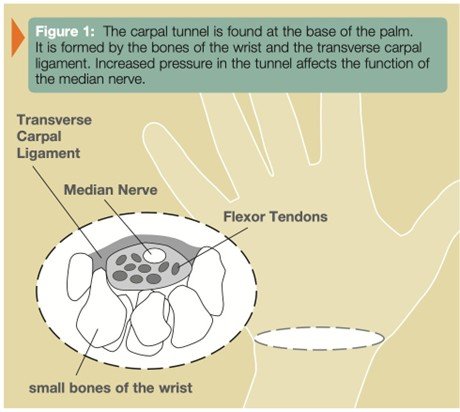
Figure 1: The carpal tunnel is formed by the bones of the wrist and the transverse carpal ligament. Increased pressure in the tunnel affects the function of the median nerve.
Warning Sign #1: Numbness and Tingling in the Thumb, Index, and Middle Fingers
The hallmark symptom of carpal tunnel syndrome is numbness and tingling — often described as a “pins and needles” sensation — in the thumb, index finger, middle finger, and sometimes the ring finger. Many patients in Bartlett, Buffalo Grove, and Wheeling tell us this sensation initially comes and goes, often appearing while driving, holding a phone, or gripping a steering wheel.
What’s important to understand is that the little finger is typically not affected. If your symptoms are isolated to the pinky and ring finger, a different nerve (the ulnar nerve) may be involved, which is something Dr. Yaffe can evaluate during a consultation.
Warning Sign #2: Symptoms That Wake You Up at Night
One of the most telling signs of carpal tunnel syndrome is nighttime symptoms. Many patients across Arlington Heights, Palatine, and the surrounding northwest suburbs report waking up in the middle of the night with numbness, tingling, or pain in their hand and wrist. This happens because most people sleep with their wrists bent, which further compresses the median nerve.
If you find yourself repeatedly shaking your hand to “wake it up” during the night, that’s a pattern Dr. Yaffe sees frequently, and it warrants an evaluation by a hand and wrist specialist.
Warning Sign #3: Weakness and Dropping Objects
As carpal tunnel syndrome progresses, many patients notice weakness in their hand — especially when trying to grip or pinch. You might find yourself dropping coffee mugs, having difficulty turning a key, or struggling to button a shirt. This happens because the median nerve also supplies the muscles at the base of the thumb.
Patients from Schaumburg, Barrington, and Hoffman Estates often mention that their hand feels clumsy or weak. If you’re experiencing this, it’s a sign the condition may be advancing and should be evaluated promptly.
Warning Sign #4: Pain That Radiates Up the Forearm
While carpal tunnel syndrome is centered at the wrist, many patients experience pain or aching that travels up through the forearm and sometimes to the elbow or shoulder. This referred pain can make the condition confusing to self-diagnose, which is why a thorough examination by an orthopedic hand specialist like Dr. Yaffe is so valuable.
At his offices in Barrington and Schaumburg, Dr. Yaffe uses a combination of physical examination techniques and, when appropriate, electrodiagnostic studies (nerve conduction tests) to confirm the diagnosis and determine the severity.
Warning Sign #5: Difficulty with Fine Motor Tasks
Have you noticed trouble texting, typing, or doing other activities that require fine finger coordination? Patients from across the northwest suburbs — including Buffalo Grove, Wheeling, and Palatine — tell us they’ve noticed declining dexterity before they connect it to carpal tunnel syndrome.
This symptom often develops gradually, making it easy to dismiss. But persistent difficulty with fine motor tasks is your body signaling that the median nerve is under sustained pressure.
For additional signs to watch for, read our guide on Carpal tunnel syndrome 7 signs you shouldn t ignore according to a hand surgeon for more information.
When Should You See a Hand Specialist?
If you’re experiencing any of these warning signs consistently for more than two weeks, it’s time to see a specialist. Early-stage carpal tunnel syndrome can often be managed with non-surgical treatments such as wrist splinting, activity modification, anti-inflammatory medications, or corticosteroid injections.
However, when symptoms are severe or have been present for a long time, carpal tunnel release surgery may be recommended. This is one of the most common and successful procedures in hand surgery, and Dr. Yaffe performs it using minimally invasive techniques that allow most patients to return to daily activities within days.
For more on the underlying causes and treatment options, see our article on Carpal tunnel syndrome causes symptoms and treatment options explained.
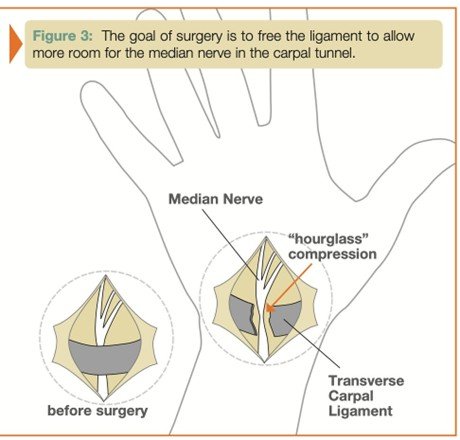
Figure 2: The goal of carpal tunnel release surgery is to free the transverse carpal ligament to allow more room for the median nerve, relieving compression and restoring normal function.
Don’t wait until you’ve lost significant hand strength or sensation. Patients throughout Schaumburg, Barrington, Bartlett, Arlington Heights, Palatine, Buffalo Grove, and Wheeling trust Dr. Yaffe and the team at Barrington Orthopedic Specialists to provide expert diagnosis and personalized treatment plans for carpal tunnel syndrome and other hand and wrist conditions.
Learn more about this option on our minimally invasive surgery page.
About Mark Yaffe, MD — Hand to Shoulder Specialist
Dr. Mark Yaffe is a highly trained orthopedic surgeon specializing in conditions of the hand, wrist, elbow, and shoulder. Board-certified and fellowship-trained, Dr. Yaffe provides expert diagnosis and personalized treatment plans — from conservative care to advanced minimally invasive surgery — for patients throughout the northwest suburbs of Chicago.
Schedule a consultation with Dr. Yaffe:
- handtoshoulderchicago.com — Dr. Yaffe’s personal practice
- barringtonortho.com — Barrington Orthopedic Specialists
