Medically reviewed by: Mark A. Yaffe, MD — Board-Certified Orthopedic Surgeon, Subspecialty Certified in Hand Surgery
 Why Does My Shoulder Hurt? Understanding Rotator Cuff Injuries
Shoulder pain is one of the most common reasons patients visit Dr. Mark Yaffe at his orthopedic offices in Schaumburg and Barrington. And for many of these patients — particularly those over 40 — the culprit is a rotator cuff injury. Whether it happened during a weekend softball game in Palatine, while doing yardwork in Arlington Heights, or gradually over years of overhead activity, a rotator cuff tear can significantly impact your ability to sleep, work, and enjoy your daily life.
The rotator cuff is a group of four muscles and their tendons that stabilize the shoulder joint and allow you to lift and rotate your arm. When one or more of these tendons becomes torn — either partially or completely — it creates pain, weakness, and limited range of motion that can be both frustrating and debilitating.
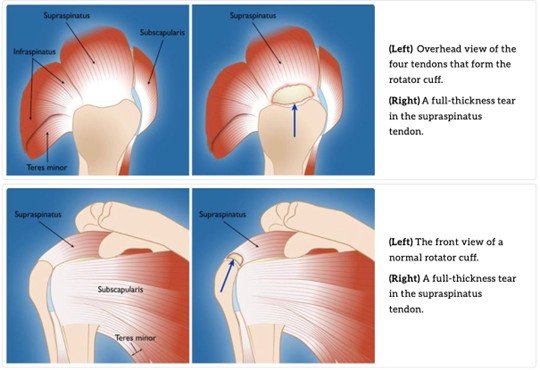
Anatomy of the rotator cuff: (Top) Overhead and (Bottom) front views showing the four tendons of a normal rotator cuff (left) compared to a full-thickness tear in the supraspinatus tendon (right).
Who Is at Risk for a Rotator Cuff Tear?
Rotator cuff tears are extremely common. Research suggests that roughly 20% of the population has some degree of rotator cuff tearing, and that percentage increases significantly with age. While traumatic injuries (such as a fall onto an outstretched arm) can cause acute tears at any age, the majority of rotator cuff tears Dr. Yaffe sees at his Barrington and Schaumburg offices result from gradual wear and degeneration of the tendon over time.
You may be at higher risk if you are over 50 years old, perform repetitive overhead motions (whether for work or recreation), have a history of prior shoulder injury, or have a family history of rotator cuff problems. Many patients in Bartlett, Buffalo Grove, and Wheeling are active individuals who first notice shoulder pain during activities like golf, tennis, swimming, or even reaching for items on a high shelf.
Common Symptoms of a Rotator Cuff Tear
The symptoms of a rotator cuff tear can vary depending on the size and location of the tear, but the most frequently reported complaints among patients across the northwest suburbs include pain at rest, especially when lying on the affected shoulder at night; a dull, deep ache in the shoulder; weakness when lifting or rotating the arm; difficulty reaching behind the back (such as fastening a bra or tucking in a shirt); and a crackling sensation when moving the shoulder in certain positions.
If you’re experiencing these symptoms and live in Schaumburg, Palatine, Arlington Heights, or the surrounding area, an evaluation by Dr. Yaffe can help determine whether you have a rotator cuff tear and what the best course of action is.
Non-Surgical Treatment Options
Not all rotator cuff tears require surgery. In fact, many patients — particularly those with partial-thickness tears or smaller full-thickness tears — respond well to conservative treatment. Dr. Yaffe’s approach always starts with the least invasive option that will effectively address your condition.
Non-surgical treatments commonly recommended include physical therapy and structured rehabilitation exercises to strengthen the surrounding muscles and improve shoulder mechanics; anti-inflammatory medications to reduce pain and swelling; corticosteroid injections for targeted pain relief; activity modification and ergonomic adjustments; and in some cases, platelet-rich plasma (PRP) therapy to support tendon healing.
For many patients in the Schaumburg, Barrington, and Palatine area, a well-designed physical therapy program can dramatically reduce pain and restore function without surgery.
For more on the injection options mentioned here, read our guide on What role does prp vs cortisone injections have in treatment of shoulder and elbow pain for more information.
These conservative approaches are commonly used across many shoulder conditions, not just rotator cuff tears.
When Is Rotator Cuff Surgery Recommended?
Surgery may be recommended when conservative treatment has not provided adequate relief after several months, when the tear is large or involves a complete rupture of the tendon, when the injury is acute (such as from a fall or trauma), or when the patient needs full shoulder strength for work or athletic activities.
The most common surgical approach Dr. Yaffe uses is arthroscopic rotator cuff repair — a minimally invasive technique that uses small incisions and a camera to reattach the torn tendon to the bone. This approach typically results in less pain, faster recovery, and smaller scars compared to traditional open surgery.
As an experienced shoulder surgeon serving the northwest suburbs of Chicago, Dr. Yaffe has performed hundreds of these procedures and takes a personalized approach to every patient’s surgical plan. His goal is always to restore your shoulder function and get you back to the activities you enjoy.
For more on when shoulder pain points toward a bigger issue, see our article on Living with shoulder pain 6 signs you may need a replacement.
What Does Recovery Look Like?
Recovery from rotator cuff surgery is a gradual process that typically unfolds over several months. In the first few weeks, your arm will be in a sling to protect the repair. Gentle passive motion exercises begin early, and active rehabilitation generally starts around six weeks after surgery. Most patients return to full activity between four and six months, depending on the size of the tear and the demands of their work or sport.
Convenient physical therapy and rehabilitation services make recovery easy for patients throughout Schaumburg, Barrington, Palatine, Bartlett, Arlington Heights, Buffalo Grove, and Wheeling.
Take the First Step Toward Relief
Shoulder pain shouldn’t be something you simply learn to live with. Whether you’re dealing with a new injury or pain that’s been worsening over months, Dr. Mark Yaffe is here to help. With offices conveniently located to serve the entire northwest suburban Chicago area, getting expert care is easier than you might think.
About Mark Yaffe, MD — Hand to Shoulder Specialist
Dr. Mark Yaffe is a highly trained orthopedic surgeon specializing in conditions of the hand, wrist, elbow, and shoulder. Board-certified and fellowship-trained, Dr. Yaffe provides expert diagnosis and personalized treatment plans — from conservative care to advanced minimally invasive surgery — for patients throughout the northwest suburbs of Chicago.
Schedule a consultation with Dr. Yaffe:
- handtoshoulderchicago.com — Dr. Yaffe’s personal practice
- barringtonortho.com — Barrington Orthopedic Specialists
